
For the third quarter of this year I set out a series of articles on Artificial Intelligence, with the aim of exploring some of the questions I consider fundamental to its adoption within organizations.
In the first, I argued that our Artificial Intelligence adoption strategy must serve the business and not the other way around, and that the gap between technology and organizations is, before it is a technology problem, a leadership problem. In the second, I looked at what Artificial Intelligence actually amplifies —the organization's knowledge— and at how much of that knowledge never gets documented, which is precisely why so many technology adoption initiatives fail.
The first two articles were about readiness. This third one is about return, about an equation. Less inspiring than the previous ones, but far more pragmatic when it comes to making decisions.
Because even an organization with a clear vision and an honest map of its own knowledge still has to answer something that no strategy document answers for it: is it worth doing this specific task with Artificial Intelligence? Not the company. Not the department. The task.
Gartner projects that worldwide spending on Artificial Intelligence will reach $2.59 trillion in 2026, 47% more than the previous year, and observes that organizations continue to favor tactical initiatives aimed at incremental improvement while their CIOs struggle to demonstrate a return. The same firm had forecast that 30% of generative AI projects would be abandoned after proof of concept by the end of 2025, and now anticipates that more than 40% of agentic AI projects will be canceled before the end of 2027, for three reasons worth noting: escalating costs, unclear business value and inadequate risk controls.
None of the three is a technical failure. All three are decisions that were never made properly.
More than a formula, a filter
This year I had the honor of meeting Rama Ramakrishnan, professor of the practice in Artificial Intelligence and machine learning at MIT Sloan, from whom I learned —and was able to put into practice— a way of framing this decision that I have found genuinely useful in the field: "the generative AI cost equation." It does not produce a number, and that is precisely where its value lies. It is a filter a management team can apply to a single task, in a single meeting, with no need for a consultant.
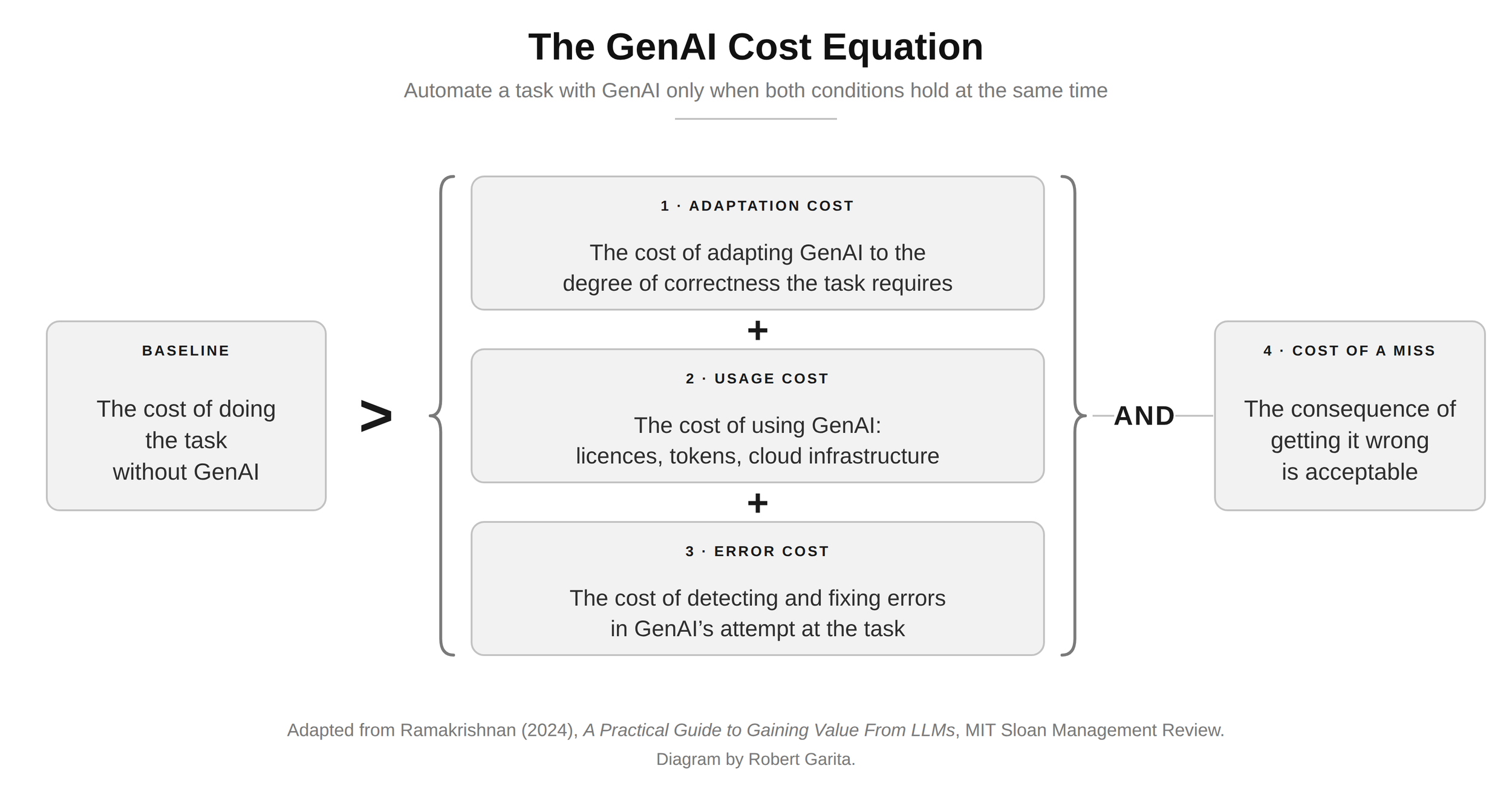
It reads from left to right, and it holds that in most cases it makes more sense to hand a task over to generative AI when what that task costs today is greater than the sum of everything the AI alternative will cost and, at the same time, when the consequences of the AI getting it wrong are consequences the organization can absorb. Two conditions that have to be examined carefully.
The left-hand side of the equation is the one organizations skip fastest (what it costs today to do the task we are evaluating), and it is the one that connects directly to my previous article. Very few organizations can say what a process actually costs them: how many hours, how many people, how much rework. When the knowledge holding that process together lives inside someone's head and was never documented, there is no baseline to compare against. A good many AI business cases collapse on that very first term.
The right-hand side has three costs that add up, and it is worth naming them separately because each one hides a different kind of problem:
Adapting the model. What it takes to bring a general-purpose tool up to the degree of correctness the task genuinely demands. A marketing draft and a credit decision do not call for the same standard, and pretending otherwise is expensive in both directions.
Using it. Licences, tokens, infrastructure. The trap here is assuming this term only goes down.
Catching and fixing its mistakes. The invisible term and, very often, the decisive one.
Once all of that has been examined, there is one last condition to evaluate, the one joined to the equation by an "and": "the cost of a miss." Last October, Deloitte agreed to partially refund the Australian government for a report that contained fabricated citations, including references to court rulings that did not exist. The refund was a fraction of the contract. The reputational cost was not, and nobody will ever put a figure on that one.
Which brings me to the point of this article. Applying this equation honestly means accepting that for a good share of our processes the right answer is no. Not "not yet." No.
That answer is one nobody presents at a board meeting, it does not go into an annual report, and no vendor is going to help us reach it. And yet the discipline of saying no is precisely what protects the budget of the initiatives that do deserve it. An organization that automates twenty processes indiscriminately will almost certainly see a worse return than one that automates five after applying the equation.
It is also, once again, a matter of governance. Someone has to be accountable for the decision not to automate, and that decision should be as documented and as defensible as the decision to invest. In most of the organizations I know, only one of the two ever gets written down.
We spend a great deal of energy asking whether Costa Rica is ready for Artificial Intelligence. I would settle for something smaller and more useful: organizations able to explain, on a single page, why they chose to automate this and not that. Here, where almost the entire business landscape is made up of small and medium-sized companies and capital is scarce, a poorly evaluated initiative does not merely deliver less than expected. It eats the budget of the one that would have worked.
Artificial Intelligence will keep getting cheaper by the unit and more expensive by the decision. The organizations that see a return will not be the ones that adopted it fastest, but the ones that were most rigorous about choosing where not to use it.
Sources and references:
Deloitte / Departamento de Servicios Sociales de Australia. (2025). Deloitte Refunds Australia After AI-Generated Report Errors. OECD AI Incidents Monitor. https://oecd.ai/en/incidents/2025-10-05-be45
Gartner. (2024). Gartner Predicts 30% of Generative AI Projects Will Be Abandoned After Proof of Concept by End of 2025. https://www.gartner.com/en/newsroom/press-releases/2024-07-29-gartner-predicts-30-percent-of-generative-ai-projects-will-be-abandoned-after-proof-of-concept-by-end-of-2025
Gartner. (2025). Gartner Predicts Over 40% of Agentic AI Projects Will Be Canceled by End of 2027. https://www.gartner.com/en/newsroom/press-releases/2025-06-25-gartner-predicts-over-40-percent-of-agentic-ai-projects-will-be-canceled-by-end-of-2027
Gartner. (2026). Gartner Forecasts Worldwide AI Spending to Grow 47% in 2026. https://www.gartner.com/en/newsroom/press-releases/2026-05-19-gartner-forecasts-worldwide-ai-spending-to-grow-47-percent-in-2026
Ramakrishnan, R. (2024). A Practical Guide to Gaining Value From LLMs. MIT Sloan Management Review. https://sloanreview.mit.edu/article/a-practical-guide-to-gaining-value-from-llms/