
Costa Rica leads Latin America in artificial intelligence adoption. The latest report from the Microsoft AI Economy Institute places the country at an adoption rate of 26.5%, representing the percentage of the working-age population using generative AI tools by the end of 2025. This positions Costa Rica among the top thirty countries worldwide.
This is good news, but it should be read carefully, because this indicator measures people, not organizations. There is an enormous difference between an employee using AI to write an email and an institution that has genuinely transformed the way it operates.
That gap has a name, and a cost. According to Boston Consulting Group, which analyzed seventy digital transformations and surveyed more than eight hundred executives, only 30% achieved their objectives. This means that seven out of ten initiatives fall short of what was “planned” and “promised.”
The cause is rarely the technology itself. It is the misalignment between two clocks moving at different speeds. Dr. George Westerman, an MIT researcher with whom I had the opportunity to study this subject, summarized it in what he calls the First Law of Digital Innovation: “Technology changes quickly, but organizations change much more slowly.”
The underlying problem is that technology advances exponentially, while we think linearly. We overestimate what a tool will accomplish next quarter and underestimate what it will achieve within a couple of years. Meanwhile, our budgets, structures, and processes remain designed for the slower-moving clock.
Costa Rica already has a National Artificial Intelligence Strategy for 2024–2027 (MICITT, 2024), which is a positive first step. However, there is a considerable gap between a national strategy and an individual organization’s strategy. This is where the real difficulty lies: each organization’s adoption strategy must respond to its vision, business objectives, operations, and governance. Never the other way around. Technology supports the business; it does not lead it.
Before allowing ourselves to be carried away by the impulse to approve the next technology budget, we should conduct an honest, internal, and, in many cases, uncomfortable assessment. For this purpose, I would like to introduce the Digital Mastery Framework, developed by George Westerman, Didier Bonnet, and Andrew McAfee through research involving hundreds of large companies and published in Leading Digital (2014).
The model is simple, and that is why it works. It brings together two dimensions:
Digital capability: the extent to which technology is embedded in the organization’s actual processes, customer experience, operations, and people’s daily work.
Leadership capability: the ability to envision a different future, engage people in that vision, and sustain change over time.
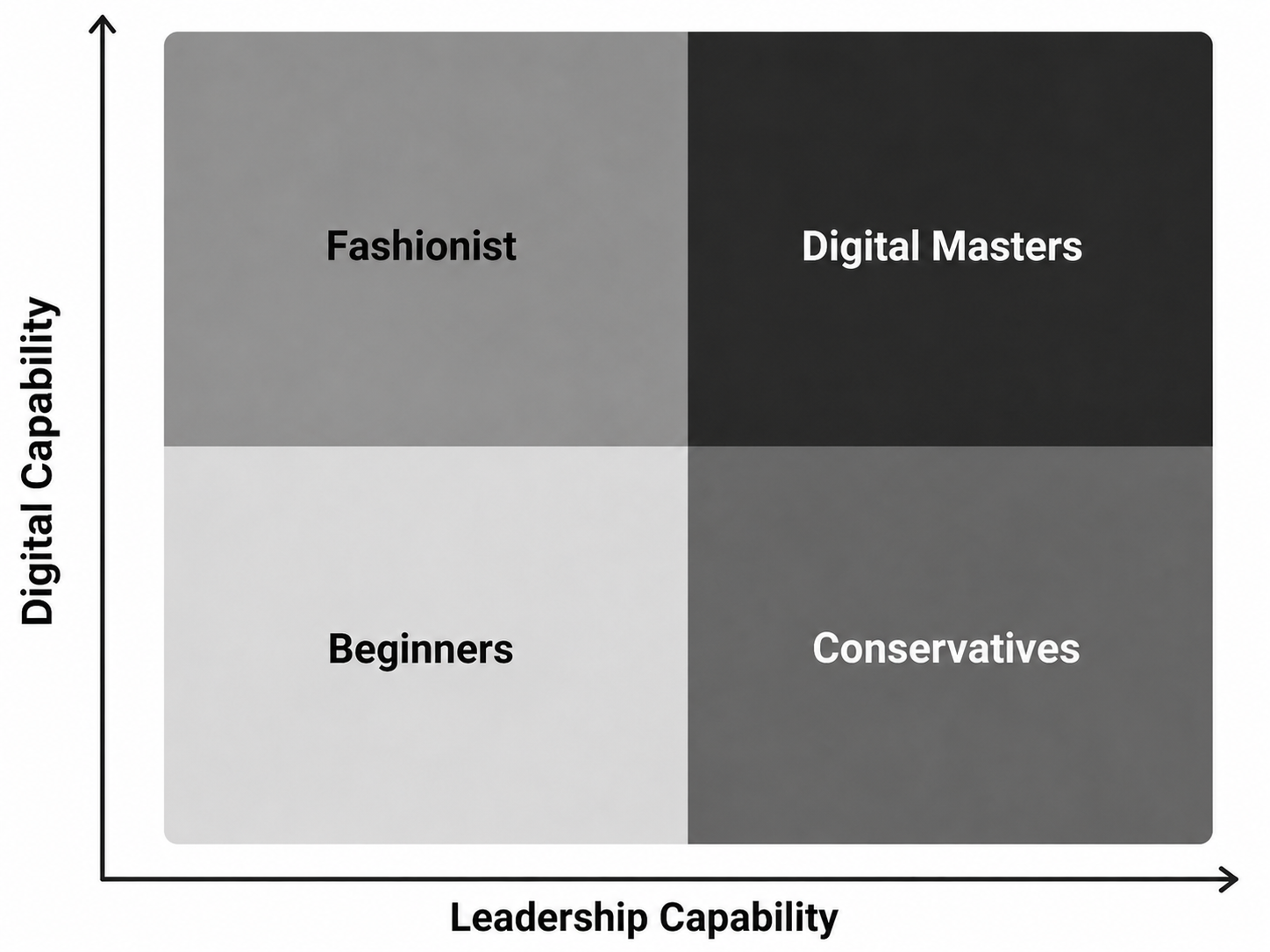
Adapted from Westerman et al. (2014)
The intersection of these dimensions produces four profiles.
Beginners: outdated systems, isolated initiatives, and leadership that reacts instead of anticipating. They view transformation as a risk rather than a priority.
Fashionistas: they buy every new technology that appears. They have all the latest tools, but no unifying vision: applications that do not communicate with one another, projects that do not scale, and victories that do not last.
Conservatives: perhaps the most common profile among mature organizations and across much of the public sector. They have strong leadership, rigorous governance, discipline, and such a high degree of caution that it ultimately becomes costly. Their vision is incremental, and because they are afraid of failure, they invest too little in innovation.
Digital Masters: they do not simply buy technology; they integrate it around a vision that their people understand and support. They innovate from the top down and from the bottom up.
Here is the point that interests me most: all four quadrants describe leadership problems, not technology problems. No organization moves into a higher quadrant by purchasing better licenses or fashionable platforms. Therefore, as you read these lines, my invitation is simple: identify where your organization currently stands. It may fit within one quadrant or perhaps somewhere between two. This self-assessment may be uncomfortable, but it explains much of what works today—and why organizations repeatedly experience failures in technology adoption.
Closing this gap is not a matter of budget, but of leadership capability. The first step is defined by the vision, not by a technology plan. It requires a vision that engages the teams responsible for implementing it, rather than becoming just another senior management KPI; a vision that inspires employees, not only directors or investors.
Next comes people’s commitment. Those who do not understand why something is changing will resist it—sometimes openly, but most often silently. Governance should not be limited to approving only what appears safe. It should also create space for internal experiments and pilot projects that sometimes fail and, at other times, teach the organization something that could never have been purchased.
Then comes the relationship between technology and the business. As long as IT is viewed as an obstacle rather than a partner, meaningful progress will remain difficult.
That 26.5% does not mean we are ready. It means we are curious, that change attracts us, and that we want to explore it. Being ready is something entirely different, and that is the uncomfortable question: whether the leadership of our organizations is ready.
Artificial intelligence will not transform any company or institution by itself. It will amplify what they already are: their clarity or disorder, their ambition or fear.
Technology will continue moving forward, with or without us. The real question is not how much AI we will purchase this year, but how fast, agile, and flexible our organizations are in adopting it with purpose.
Sources and References:
Boston Consulting Group. (2020). Flipping the Odds of Digital Transformation Success.
https://www.bcg.com/publications/2020/increasing-odds-of-success-in-digital-transformationMicrosoft AI Economy Institute. (2026). AI Diffusion Report 2025 H2.
https://www.microsoft.com/en-us/corporate-responsibility/topics/AI-Economy-Institute/reports/Global-AI-Adoption-2025/Ministry of Science, Innovation, Technology and Telecommunications (MICITT). (2024). Costa Rica’s National Artificial Intelligence Strategy 2024–2027.
https://micitt.go.cr/el-sector-informa/micitt-presento-estrategia-nacional-de-inteligencia-artificial-eniaWesterman, G. (2019). The First Law of Digital Innovation. MIT Sloan Management Review.
https://sloanreview.mit.edu/article/the-first-law-of-digital-innovation/Westerman, G., Bonnet, D., & McAfee, A. (2014). Leading Digital: Turning Technology into Business Transformation. Harvard Business Review Press.
Published in La República newspaper on July 27, 2026.👈 (spanish version)