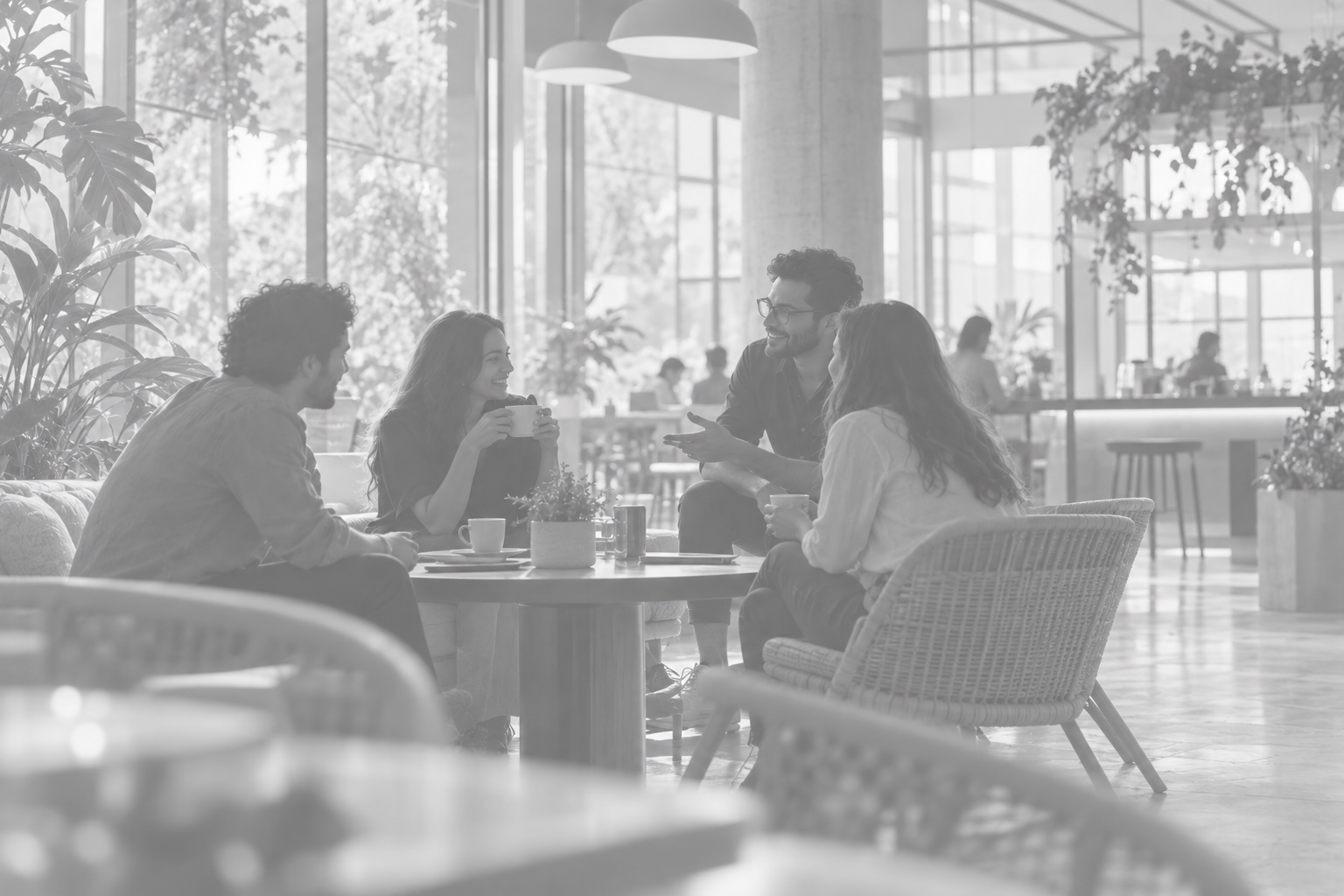
When technology fades into the background, experience comes forward
For decades, technology has transformed the way we work, learn, and connect with one another. The telephone reduced distance, the internet changed access to knowledge, mobile devices allowed us to work from almost anywhere, and more recently, artificial intelligence has accelerated that transformation even further.
But there is another consequence of this evolution that we talk about far less:
when the way we do things changes, our relationship with the spaces where we do them changes as well.
For a long time, there was a relatively clear relationship between activity and place. We went to an office to work, to a university to learn, to a library to access knowledge, and to a laboratory to experiment.
Technology has gradually disrupted those relationships.
Today, we can join a meeting from another country, learn from home, collaborate on a document in real time, or access from a phone an amount of information that only a few decades ago would have required several visits to a library.
Artificial intelligence is simply the latest acceleration of this phenomenon. Many activities that once depended on specific people, tools, and places can now be carried out from a computer.
And that raises an interesting question:
if we increasingly need fewer specific places to perform a task, why do we still need physical spaces?
This is where what we might call the spatial paradox of technology appears: precisely because we can do more and more from anywhere, the moments when we choose to come together physically may become increasingly valuable.
This does not mean we need more spaces. It means we need better reasons to occupy them.
For much of modern history, we designed spaces around functions. The factory organized people around machines, the office around desks, and the classroom around a primary source of knowledge.
But when many of those functions are no longer tied to a specific place, the purpose of space begins to shift.
An office can no longer justify its existence simply because work can happen there. A university cannot rely only on the fact that knowledge is found there. A library is no longer relevant merely because it stores information.
Its value begins to move from facilitating a task to facilitating an experience.
The Gensler Research Institute has been studying this transformation closely. Its Global Workplace Survey 2026, based on 16,459 office workers across 16 countries, found something particularly interesting: the most intensive users of artificial intelligence spend less time working alone and more time learning and socializing. They also report stronger team relationships.
That is an important signal because it challenges the assumption that more technology automatically means less human contact.
Perhaps something else is happening:
technology does not eliminate our need to come together; it changes the reason we want to do so.
And that also transforms how we think about space.
For years, we associated technologically advanced environments with screens, sensors, automation, and devices. But perhaps true technological maturity happens when we stop noticing the technology.
When it operates quietly in the background and allows our attention to return to people and experiences.
Then the design questions begin to change.
It is no longer only about where to place a screen or how to connect a meeting room. It becomes a question of where a spontaneous conversation can happen, where we can learn by observing someone else, where we can experiment, where an unexpected encounter might occur, or where an idea can become something tangible.
Space stops being only a container for activities and begins to become a catalyst for behavior.
This becomes especially relevant when we think about how we learn.
Not all knowledge is written down.
We can document procedures, methodologies, and processes, but there are many things we learn only through proximity and experience: watching how someone solves a problem, participating in a conversation, asking questions, making mistakes together, or simply sharing a table.
This is what we understand as tacit knowledge.
Technology is extraordinarily effective at storing, organizing, and distributing explicit knowledge. Artificial intelligence takes that capability even further.
But precisely because of that, what cannot easily be documented starts to become more valuable.
Physical space can then become a critical infrastructure for allowing that knowledge to circulate. Gensler’s related research suggests that learning-oriented employees are more likely to experiment with new ways of working, while much of their learning happens informally through observation, spontaneous questions, and real-time knowledge sharing.
This transformation is also beginning to blur traditional boundaries. Offices are starting to look a little more like schools because learning has become a permanent part of work. At the same time, universities are starting to look less like collections of traditional classrooms because a lecture or explanation can increasingly be accessed digitally from almost anywhere.
In both cases, spaces for experimentation, collaboration, making, conversation, and learning by doing become more important.
Gensler makes a similar argument in education: as AI personalizes instruction and automates some forms of routine learning, campuses can increasingly focus on what these technologies cannot easily reproduce — collaboration, community, and creativity. Libraries, incubators, makerspaces, and other third spaces therefore take on greater significance.
Perhaps we should stop thinking only in terms of categories such as office, university, or laboratory, and begin thinking instead about ecosystems for learning, creating, and connecting.
Because as technology makes functional tasks easier, the responsibility of physical space increases.
If someone needs to travel to an office, a university, or an innovation center, that place should offer something that is difficult to find in front of a screen: a conversation that would not otherwise have happened, a person to learn from, an unexpected idea, an experiment, a relationship, or simply a sense of belonging.
For years, we assumed that the more technology advanced, the less important space would become.
Perhaps we are beginning to discover the opposite.
The future of our spaces will probably not be defined by how much technology we can put into them, but by how well we use technology so that, when we choose to come together, we can focus on what really matters.
And perhaps the question that should guide this next generation of spaces is a very simple one:
if technology allows us to do more and more from anywhere, what should happen when we choose to be together?
Sources
Gensler Research Institute, Global Workplace Survey 2026. Gensler
Gensler, The Human Side of AI: What Power Users Are Telling Us About the Workplace, 2026. Gensler
Gensler, A New Value for the Workplace in an Era of AI, 2026. Gensler
Gensler, More Human, Not Less: Rethinking the Office with AI, 2026. Gensler
Gensler, Education — Expertise and Designing Campus Spaces for Tomorrow’s Workers in the Age of AI.